How to Choose the Right Software Development Agency in Delhi for Your Business
Archit Bhatt
Author & Tech Team
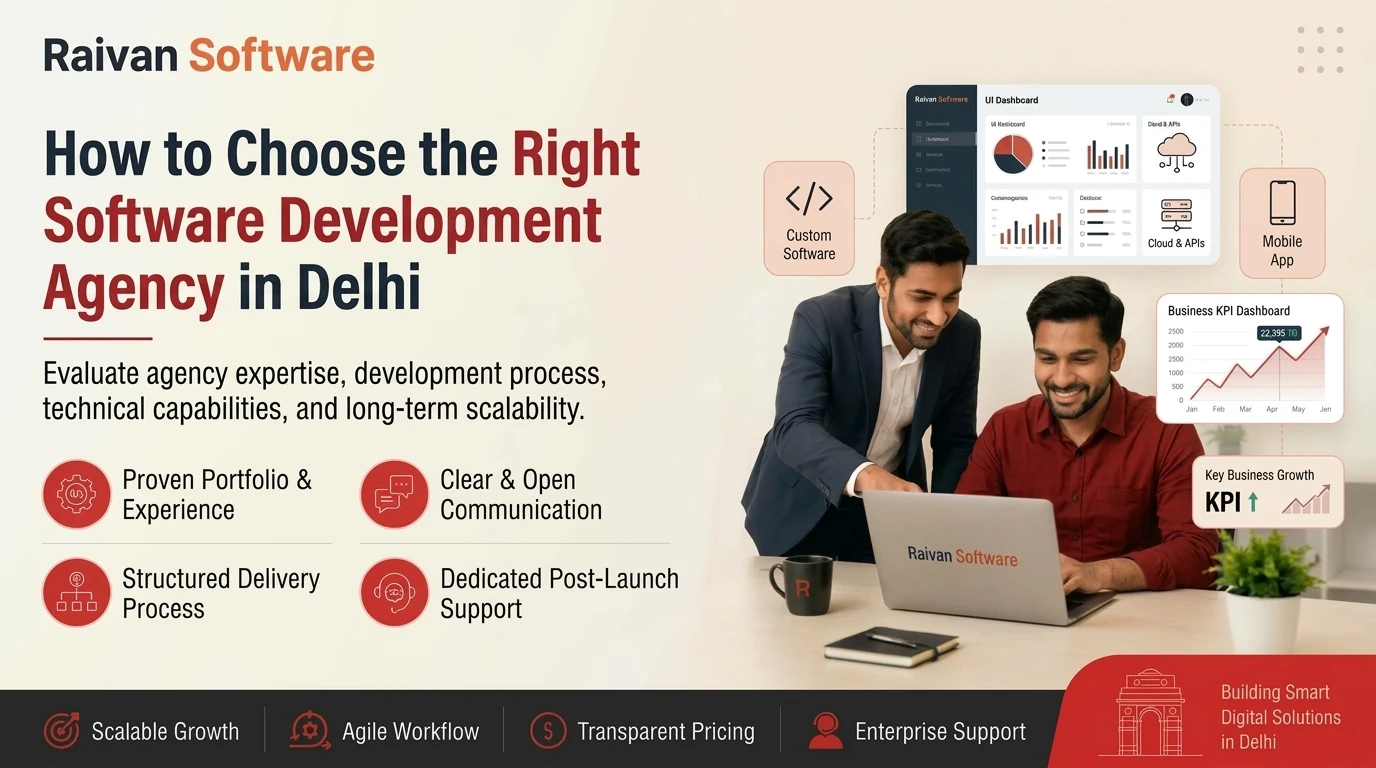
How to Choose the Right Software Development Agency in Delhi for Your Business
Choosing a Software Development Agency in Delhi can be a big decision, especially when you are investing in software that your business may use for several years. Whether you need a mobile application, web application, business management system, CRM, ERP, or a completely customized platform, the development partner you choose can affect the final product, budget, and overall experience.
The difficult part is that there are many options available. Some companies focus on startups, some work mainly with established businesses, while others specialize in particular technologies or industries. From a business owner's point of view, it can be difficult to know which one is actually right for the project.
This guide is meant to make that decision easier. Instead of simply looking at prices or technical terms, we'll look at the things that actually matter when choosing a development partner.
Why Do Businesses Hire a Software Development Agency?
Many businesses start with ready-made software because it is quick to set up and usually costs less in the beginning. But as the business grows, those tools may not always fit the way the company works.
For example, a business might have a separate tool for managing customers, another for employees, another for payments, and another for reports. Employees may have to move information between different systems. Apart from taking extra time, this can also create errors.
A development agency can help bring these processes into one system.
Depending on the business, software can be used for:
- Customer and lead management
- Sales and inventory tracking
- Employee management
- Payment processing
- Business automation
- Reporting and analytics
- Booking and appointment management
- E-commerce operations
- Internal communication
The right solution depends on the actual problem you are trying to solve. You don't necessarily need complex software just because your competitors have it.
How Do You Know What Software Your Business Needs?
This is one of the first questions you should answer before approaching a Software Development Agency in Delhi.
Start with the problem instead of the technology.
For example, don't begin with, "I need an AI-based application." First ask, "What problem will AI solve for my business?"
Similarly, instead of saying, "I need ERP software," identify which business processes you want to manage through it.
Think about:
- What takes too much time in your current process?
- Where are employees making repetitive entries?
- Which tasks could be automated?
- What information is difficult to track?
- Are you using too many separate tools?
- What problems do your customers face?
Once you understand the problem, discussing the right solution with a development team becomes much easier.
What Should You Look for in a Software Development Agency in Delhi?
Not every development company will be suitable for every project.
Start by checking their previous work. A portfolio can tell you whether the team has experience with projects similar to yours.
For example, if you need a business management platform, look for experience with dashboards, user roles, databases, APIs, and business workflows. If you're building a mobile app, check whether the company has experience creating applications that are easy to use and maintain.
You should also consider:
- Technical expertise
- Previous project experience
- Communication process
- Development timeline
- Testing approach
- Pricing transparency
- Post-launch support
- Ability to scale the software
A good agency should be interested in understanding your business before suggesting a solution.
Why Is Custom Software Sometimes a Better Option?
Custom software development is not necessary for everyone.
If an existing product already solves your problem, using it may be the more sensible option. There is no reason to spend extra money building something from scratch when you don't need to.
However, custom software can become valuable when your business has specific requirements.
For example, suppose you operate a service business where customers submit requests online, employees are assigned those requests, payments are collected through different methods, and managers need to monitor everything through one dashboard.
A standard tool may not handle the entire workflow.
This is where custom software development can help. The software can be designed around the way your business actually operates.
It can include features such as:
- Custom dashboards
- Automated workflows
- Customer portals
- Employee management
- Role-based access
- Payment integration
- API integration
- Business-specific reports
The main advantage is flexibility. You are not forced to change your business process just because the software doesn't support it.
What Is the Difference Between Ready-Made and Custom Software?
This is a common question among business owners.
Ready-made software is already developed and can usually be started quickly. It may be suitable when your requirements are fairly standard.
Custom software, on the other hand, is developed according to your requirements. It normally takes more time and investment, but it gives you greater control over features and workflows.
A simple way to decide is to ask:
Does the existing software solve my problem properly?
If the answer is yes, ready-made software may be enough.
If the answer is no and the limitation is affecting your business, custom development may be worth considering.
How Important Is Communication During the Project?
Technical skills are important, but communication is often overlooked.
Software projects can involve many discussions about features, designs, changes, testing, and deadlines. If communication is unclear, even a technically good project can become stressful.
Before hiring an agency, ask how the project will be managed.
For example:
- Who will be your main contact?
- How often will you receive updates?
- How will you provide feedback?
- Can you review the software during development?
- How will changes in requirements be handled?
You don't need to have meetings every day. What matters is knowing what is happening with your project.
A good Software Development Agency in Delhi should be able to explain technical decisions in language you can understand.
How Much Does Software Development Cost in Delhi?
There isn't a single price for software development.
Two businesses can ask for "an app" and receive completely different quotations because their requirements are different.
The cost can depend on:
- Number of features
- Project complexity
- UI/UX requirements
- Technology stack
- Web or mobile platform
- Third-party integrations
- Payment gateway requirements
- Security requirements
- Testing
- Maintenance and support
This is why comparing agencies only on the lowest price can be misleading.
Suppose one company quotes ₹2 lakh and another quotes ₹3 lakh. Before deciding that the first company is cheaper, check what both quotations include.
The second quotation might include design, testing, deployment, support, and several features that aren't included in the first one.
A clear scope is more useful than simply chasing the lowest number.
Why Should You Think About Scalability?
Your software should solve today's problem without creating tomorrow's problem.
A startup might begin with 100 users but eventually have thousands. An internal business application may initially be used by five employees and later by several departments.
That's why scalability should be discussed before development starts.
This doesn't mean building every possible feature from day one. Instead, the system should be planned so that additional users, features, integrations, and data can be handled later.
Tell your development team about your future plans. Even if a particular feature isn't needed right now, knowing where the business is heading can influence technical decisions today.
What About Security and Data?
For many businesses, software handles important information such as customer details, employee records, transactions, and business data.
So security shouldn't be treated as an afterthought.
Ask the development team how they plan to handle things like:
- User authentication
- Access permissions
- Data protection
- Secure APIs
- Backups
- Error handling
- Software updates
You don't need to understand every technical detail. The important thing is that security has been considered as part of the project rather than added at the very end.
Should You Choose a Local Delhi Development Agency?
Working with a local agency can be convenient, particularly if you prefer face-to-face meetings or want a team that understands the local business environment.
However, location shouldn't be your only deciding factor.
A company outside your immediate area can also be a good choice if it has the right expertise, communication process, pricing, and support.
So rather than asking only, "Are they based in Delhi?" ask:
Can this team understand my requirements and deliver the project properly?
That's the more useful question.
What Should You Check Before Signing the Agreement?
Before you finalize a Software Development Agency in Delhi, take a little time to review the complete proposal.
Check:
- Project scope – What exactly will be developed?
- Features – Are all important features clearly mentioned?
- Timeline – When will each stage be completed?
- Cost – What is included in the quoted amount?
- Payment terms – When are payments due?
- Testing – How will bugs be identified and fixed?
- Ownership – Understand ownership of the final software and relevant project assets.
- Support – What happens after the software goes live?
- Future updates – How will additional features be handled?
Getting these details in writing can prevent misunderstandings later.
Final Thought
Choosing a Software Development Company in Delhi isn't simply about finding someone who can build an application.
The real goal is to find a development partner who understands your business problem and can turn that requirement into software that people can actually use.
Don't select a company only because its quotation is the lowest. Look at its previous work, ask practical questions, understand the development process, and make sure the communication is comfortable from the beginning.
If your business has a simple requirement, a ready-made solution may be enough. But if your processes are unique or existing tools are holding you back, custom software development can give you much more flexibility.
Take the time to make the right choice at the beginning. It can save your business considerable time, money, and frustration later.
Frequently Asked Questions
1. What does a Software Development Agency in Delhi do?
A software development agency helps businesses plan, design, develop, test, launch, and maintain software solutions such as websites, mobile applications, web applications, CRM systems, and business software.
2. How do I choose the right software development agency?
Look at the agency's portfolio, technical expertise, communication process, pricing, development timeline, testing approach, and post-launch support. Also make sure they understand your business requirements.
3. Is custom software development suitable for small businesses?
It can be, but it depends on the business problem. If existing software doesn't support your workflow and the limitation is affecting operations, custom development may be useful.
4. How much does custom software development cost?
There is no fixed cost. The price depends on features, complexity, design, integrations, technology, development time, testing, and support requirements.
5. How long does it take to build custom software?
The timeline depends on the project's scope. A relatively simple application may take less time, while a complex business platform with multiple integrations and user roles can take considerably longer.
6. What should I ask a software development agency before hiring?
Ask about similar projects, technology recommendations, project management, communication, testing, timeline, pricing, ownership, security, and support after launch.